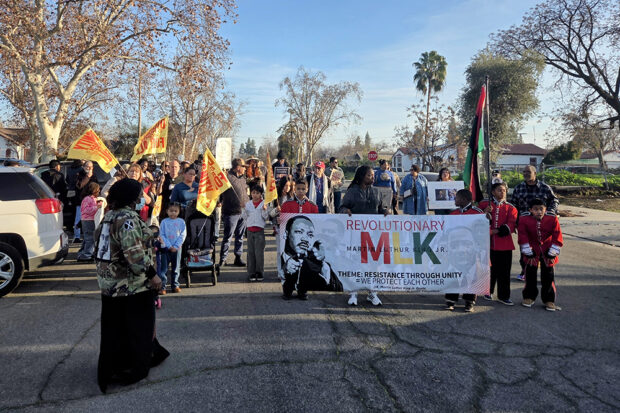
The Revolutionary MLK Organizing Committee of Fresno is a community-led effort focused on honoring Dr. Martin Luther King Jr.’s radical legacy, especially concerning his economic justice and antiwar stances. On Jan. 19 at the Free AME Church in West Fresno, the committee held a community event to honor King’s revolutionary actions and words.
On April 4, 1967, exactly one year before his assassination, King delivered a speech titled “Beyond Vietnam,” his first major speech on the war in Vietnam. King linked the U.S. commitment to that war to its abandonment of the commitment to social justice at home.
His call for a “shift from a ‘thing-oriented’ society to a ‘person-oriented’ society” and for us to “struggle for a new world” has acquired even greater urgency in the decades since. The speech concludes with “a nation that continues year after year to spend more money on military defense than on programs of social uplift is approaching spiritual death.”
On March 30, 1967, he said that “our only hope today lies in our ability to recapture the revolutionary spirit and go out into a sometimes hostile world declaring eternal hostility to poverty, racism and militarism.
“The evils of capitalism are as real as the evils of militarism and racism. The problems of racial injustice and economic injustice cannot be solved without a radical redistribution of political and economic power.”
The Fresno event included a rally and march and a panel discussion. At the rally, community activist Taymah Jahsi spoke to about a hundred community members gathered to honor Dr. King.
“He was nonviolent and we know that, and we also know that you can’t pull on the heartstrings of this government to get what you want,” she said.
“The oppressors aren’t going to hand you your freedom. Dr. King was ahead of his time with his strategy.
“What do you think if Martin Luther King had told his people to fight back? What would they [the government] have done? What do they do when you fight back now?”
Cam Fanning, president of the Fresno branch of the Womxn’s International League for Peace and Freedom, said, “I want to speak about allyship by challenging the system we [whites] benefit from. Disrupting the status quo and refusing to just go along with it.
“I grew up in the Deep South, and racism there is not subtle, it’s not a thing of the past. It’s structural and it’s personal, first learned from your family and your teachers. I have endless stories about white racism growing up.“
Kenisha Daily of All Things Fresno noted that “Dr. King is remembered for his crusades for racial justice, but what is frequently left out of the story is his intentional shift from racism alone to class, poverty and power.
“The issues Dr. King named, housing insecurity, poverty and the unequal distribution of power, have plagued the homes and streets of Fresno long before his visit here in June of 1964 and they persist today.
“To truly honor Dr. King’s life and his message, we must be willing to act, and there is a lot of work to do.”
Fresno civil rights leader Aline Reed told the crowd that “today is the latest edition of a resistance movement that has been going on since the 1600s in the Americas.
“MLK died because he was a part of this movement; 250,000 Black soldiers died for this so-called freedom. This was our down payment as Black people.
“I want to remind you of Fannie Lou Hamer and the Black Panther Party for Self-Defense, who were killed maimed and brutalized on a regular basis for standing up for what so many European Americans take for granted.”
After a short march, there was a panel discussion titled “From Nonviolence to Black Power” that included Dr. Malik Simba, Homer Gee Greene, Irene Parra Serrano and Stan Santos.
Dr. Floyd Harris Jr., pastor of Free AME Ministries, welcomed the audience. “If you are here today, you have to be a revolutionary. If not, you need to leave.
“As Malcolm X said, ‘we are not outnumbered, we are out organized.’ It’s true, there’s more of us than them, [and] we are at a stage now where we have to organize as a people.”
Simba, professor emeritus at Fresno State, opened the panel discussion. “There were thousands of people that participated in those marches [during the 1960s]. One, Anne Moody, was a foremost leader in the Student Nonviolent Coordinating Committee.
“Her autobiography is titled Coming of Age in Mississippi. It begins with the murder of Emmett Till with her mother telling Anne when she was 10 years old that ‘that boy was no good and an evil spirit got him,’ referring to the KKK.
“Her mother told her, ‘If you are not a good girl, that evil spirit will get to you.’ That’s what you learned at age 10, vis-à-vis the murder of Emmett Till.
“The title of her book [speaks to] the coming of political age, to become an active, political, organized activist in SNCC.
“I suggested the title of this panel to be ‘From Nonviolence to Black Power’ because that is the history of Anne Moody and the young students that pushed Dr. King to be more aggressive.
“So when Stokely Carmichael yelled [‘We have been saying freedom for six years and we ain’t got nothin’. What we got to start saying now is Black Power!’] at the March Against Fear in Greenwood, Miss. [in 1966], it was about fear.
“Fear is a constant when you talk about white supremacy. And you could not have had Barack Obama as a two-term president without the March Against Fear.”
Simba spoke of the tragic murder of Renee Good and acknowledged the hundreds of civil rights activists murdered by the state during the civil rights movement.
Greene, a freelance writer and community activist, said “a few words about Renee Good from a philosophical point of view. She was representative of the diversity of America, she was a white woman, was a mother of a biracial child, progressive, and believed in the abolitionist constitution of 1865.
“She became what she became because of the abolitionist constitution—the 13th, 14th and 15th amendments.
“Trump is trying to bring back the Confederate Constitution. This is what we have to fight against. It’s not going to go away, it’s going to get worse because Republicans and MAGA are cowards and opportunists.”
Greene spoke of John Lewis and “good trouble” and said that “when you fight against MAGA, racism, sexism [and] misogyny, you do it with good trouble, you do it nonviolently.
He went on to exhort voters to vote blue and to register others to vote ascertaining that “none of this would have happened if Kamala Harris had won!”
Serrano of the Chicano Youth Center said that “resistance brought us here today. We didn’t come here to this sacred place to be fed the watered-down conservative version of brother King today.
“That’s the view that fits their agenda, the version that consoles them while they kill our sons, our fathers and our brothers on the streets, while they kidnap our loved ones and neighbors. It’s the view [of those] that watch our unhoused brothers and sisters freeze in the cold.
“It [was] a slap in the face to listen to [Fresno Mayor] Jerry Dyer talk about our brother King as if he was a friend. Jerry Dyer—who justified ICE terrorism in front of hundreds of people [at a City-sponsored event].
“But I have no doubt in my mind that brother Martin Luther King would be standing here with us today, fighting the good fight. Fighting against police brutality and fighting against the racial profiling that is terrorizing so many of our communities right now.
“If he was that watered-down version they want us to believe, he’d still be alive today.”
In closing, Serrano had a message for the youth in attendance: “All of our movements have been led by youth. Take your rightful place. It’s you who are brave, and it’s you who will lead us!”
Panelist Santos from Raza Against War spoke of war and imperialism, issues Dr. King repeatedly lectured about. “The Trump administration is riding high with bravado and imperialist swagger backed up by an extreme capacity for violence in our cities and other countries, [yet] they have not learned some very valuable lessons.”
He then spoke of historical examples of the military defeat of imperialist powers, saying that “the king’s armies and the U.S. imperialists can be defeated as was proven in the battle for Jerusalem, the Anglo/Zulu War and Custer’s last stand.
“It proves that indigenous forces, when equipped with matching technology, or sufficient numbers and the ability to maneuver strategically, can match the imperialist forces of the U.S.
“I’m not suggesting that we go to war, but we have to lift that veil, and that, in fact, we’re going to engage in war in Latin America, with countries that have populations of hundreds of millions, who have been fighting for years and years. They’re going to come up against this [imperialism] in a way that makes the war in the Middle East [look like] just another battle.”
The panelists were well received by the audience, and there was a lively Q&A at the end of an informative meeting.