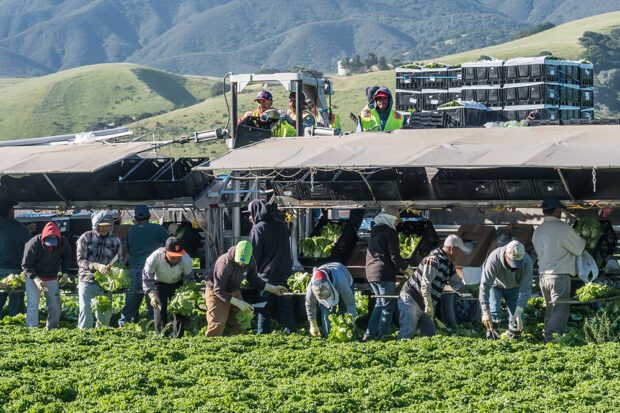

The Central Valley is a fertile farm belt that expands for about 20,000 square miles and supplies one-fourth of the nation’s food. Fresno County alone is considered one of the most agriculturally productive counties in the country and is home to the region’s largest farmworker population.
Despite robust agriculture in Fresno County, more than half of the farmworkers living there are food insecure. Food insecurity is defined as the “limited access or lack of access to a nutritionally sound and culturally appropriate diet from reliable mainstream sources.”
In the United States, where our current food system provides 4,000 calories per person, which is one and a half times more than the amount needed, the production of hunger is the result of intentional policies that exclude immigrants from basic necessities like food.
Sociologist Tanya Maria Golash-Boza states that the position of farmworkers in America resulted from job restructuring after neoliberal reforms in the Global South pushed many to migrate to the United States.
Moreover, the North American Free Trade Agreement (NAFTA) forced subsistence farmers from Mexico into farming jobs in the United States when U.S. crops flooded the market in Mexico at lower prices made possible by subsidies from the U.S. government, making it impossible for Mexican farmers to compete.
From its beginning, the agrarian capitalism of California was reliant on the influx of farmworkers from Mexico to create the highest profits while farmworkers survived on the thinnest margins. The U.S. Farm Bureau and California farmers fabricated the need for cheap Mexican labor by first legalizing the supply through the Bracero Program in 1943 to increase agricultural output needed during World War II, allowing for 200,000 Mexican nationals to enter the United States legally.
A year after the Bracero Program ended, the Hart-Celler Act of 1965 capped immigration from the entire world to 120,000 people. This was a slap in the face for many farmworkers who had toiled on U.S. farms only to be treated as disposable.
In the words of President Harry S. Truman, Mexican braceros were “ready to go to work when needed; to be gone when not needed.”
Agrarian capitalism continues to devalue the labor of farmworkers by underemploying the labor force. There are approximately 882,000 farmworkers to fill 412,300 jobs, creating an environment rife for exploitation where excess farmworkers can be deported “when not needed.”
Furthermore, farmworkers are responsible for the reproduction of their own labor. The oversupply of farmworkers to jobs forces farmworkers to perennially look for work.
Farmworkers are prone to higher levels of food insecurity because they are not employed throughout the year. It is estimated that farmworkers are employed at rates only half those of regularly employed workers.
For the transgression of being “illegal,” farmworkers are sanctioned by being denied access to means-tested programs and the food from the farms where they work. Without year-round employment and access to CalFresh (Supplemental Nutrition Assistance Program), food insecurity among farmworkers persists.
Food insecurity in Fresno County is defined by its persistent poverty—a state of poverty affecting at least 20% of the population.
Due to the large presence of farmworkers in the Central Valley, the solutions to address food insecurity should focus on the expansion of CalFresh benefits to all, regardless of legal status. In Fresno County, there are approximately 72,000 farmworkers, 82% of whom come from Mexico. Farmworkers are likely to be male, single and approximately 39 years old.
Compared to different geographical regions, immigrants in the Central Valley are least likely to have a path toward citizenship, and it is estimated that 75% of farmworkers in California are undocumented. During the Covid pandemic, undocumented farmworkers were excluded from receiving stimulus checks and immigrant women were among those most likely to lose their employment.
The low naturalization rate in Fresno County (44.2%) and overrepresentation of Mexican nationals in the farmworker population are examples of how agrarian capitalism’s demand for a reserve army of labor relies on the exploitation of immigrants who have little legal protection.
Rep. Brandon Gill, a MAGA Republican from Texas, recently shared on social media that “cotton was still harvested after slavery ended, and our food will continue to be picked after mass deportation.”
According to Golash-Boza, threats of mass deportation are messages that keep labor compliant through fear. Farmworkers are beholden to the legal landscape shaped by the U.S. Farm Bureau, which favors the interests of farmers. The Farm Bureau has historically opposed farmworker protections, including the Farm Workforce Modernization Act, which proposed a legal pathway for citizenship for farmworkers
.
Efforts to solve food insecurity by the California Department of Food and Agriculture’s Office of Farm to Fork (CDFA-F2F) exclude farmworkers. CDFA-F2F created a working group with different stakeholders in the Central Valley to address the issues affecting the most marginalized communities. Included among the working group was the Farm Bureau but not the United Farm Workers (UFW).
At the state level, the economic interests of big agriculture trump the human rights of farmworkers. State Senator Melissa Hurtado (D–Bakersfied), who represents the southwest Central Valley, proposed the Food4All Act (SB 245) to extend CalFresh benefits to undocumented immigrants. However, the bill was modified to allow only undocumented immigrants 55+ to be eligible for services, even though the average age for farmworkers is 39.
CDFA-F2F operates from the position of promoting food with dignity, but dignity is not extended to farmworkers. Our appreciation for farmworkers is based on moral grandstanding; we seemingly understand that they provide for our meals while commodifying their labor.
Cal/OSHA heat protection enforcements have declined 30% over the past seven years even as we continue to have climate-related heat waves. In response to the UFW requesting workers’ compensation for heat-related accidents, Governor Gavin Newsom decided it was not in the fiduciary interest of the state to do so.
In our current political climate of protectionism and nativism, we have scapegoated immigrants as the reason for our economic hardships although they contributed $8.5 billion to California’s economy in 2022.
To address food insecurity in Central Valley farmworker communities, we should first decommodify their labor by advocating for work protections from the environment and employer retaliations. The contributions of farmworkers are vital to our existence although their existence is out of sight, out of mind.
Expansion of CalFresh benefits should include all people as our food system is robust enough to feed everyone. Employers should face legal sanctions if Cal/OSHA heat protections are not enforced.
To ensure that farmworkers are considered in legislation that addresses food insecurity in the Central Valley, the relevant state-level departments should be audited for any conflicts of interest.
If food insecurity can only be solved within the current framework through government programs such as CalFresh, a path to citizenship should be considered to afford farmworkers access to means-tested programs and eligibility to employment that provides year-round employment with benefits.
Solutions within the current framework will only reproduce the conditions that create hunger among farmworkers if they exclude people on the basis of legal status.
References
U.S Geological Survey (USGS). “California’s Central Valley.” Retrieved December 15, 2024. (https://ca.water.usgs.gov/projects/central-valley/about-central-valley.html).
Brown, Sandy, and Christy Getz. 2011. “Farmworker Food Insecurity and the Production of Hunger in California.” Pp.121-146 in Cultivating Food Justice: Race, Class, and Sustainability, edited by A.H Alkon and J. Agyeman. Cambridge: MA: MIT Press.
Guptill, Amy E., Denise A. Copelton, and Betsy Lucal. 2022. Food & Society. 3rd ed. Hoboken, NJ: Polity Press.
Golash-Boza, Tanya Maria. 2015. Deported: Immigrant Policing, Disposable Labor, and Global Capitalism. New York, N.Y.; London: New York University Press.
Brown, Sandy, and Christy Getz. 2011. “Farmworker Food Insecurity and the Production of Hunger in California.” Pp.121-146 in Cultivating Food Justice: Race, Class, and Sustainability, edited by A.H Alkon and J. Agyeman. Cambridge: MA: MIT Press.
García Hernández, César Cuauhtémoc. 2019. Migrating to Prison: America’s Obsession with Locking up Immigrants. New York: The New Press.
García Hernández, César Cuauhtémoc. 2019. Migrating to Prison: America’s Obsession with Locking up Immigrants. New York: The New Press.
Hooker, Brandon, Philip Martin, Zachariah Rutledge, and Marc Stockton. 2024. “California Has 882,000 Farmworkers to Fill 413,000 Jobs.” California Agriculture 78(1). doi: (https://doi.org/10.3733/ca.2024a0005).
Brown, Sandy, and Christy Getz. 2011. “Farmworker Food Insecurity and the Production of Hunger in California.” Pp.121-146 in Cultivating Food Justice: Race, Class, and Sustainability, edited by A.H Alkon and J. Agyeman. Cambridge: MA: MIT Press.
Benson, Craig, Alemayehu Bishaw, and Brian Glassman. 2023. “341 U.S. Counties Experiencing Persistent Poverty.” United States Census Bureau. May 22. Retrieved December 15, 2024. (https://www.census.gov/library/stories/2023/05/persistent-poverty-areas-with-long-term- high-poverty.html).
National Center for Farmworker Health (NCFH). 2023. Farmworker COVID-19 Community Assessments Fresno County, California. May. Retrieved December 15, 2024. (https://www.ncfh.org/wp-content/uploads/2025/04/ncfh_fcca_fresnocountyca_fwhreport _may2024_1.pdf).
La Cooperativa Campesina de California. 2023.“31 California Farmworker Facts You Should Know.” March 28. Retrieved December 15, 2024. (https://lacooperativa.org/31-california-farmworker-facts-you-should-know/).
Community and Labor Center (CLC). 2021. Valley Economic Fact Sheet. UC Merced. August. Retrieved December 15, 2024. (https://clc.ucmerced.edu/sites/g/files/ufvvjh626/f/documents/vps_valley_economic_fact _sheet.pdf).
Gill, Brandon. 2025. “Cotton was still harvested after slavery ended and our food will continue to be picked after mass deportation.” X. February 25. Retrieved December 15, 2024. (https://x.com/RepBrandonGill/status/1894514406802731477).
Golash-Boza, Tanya Maria. 2015. Deported: Immigrant Policing, Disposable Labor, and Global Capitalism. New York, N.Y.; London: New York University Press.
UFW Foundation. 2022. “Senate Republicans and American Farm Bureau Deny Farm Workers Legal Status.” December 22. Retrieved December 15, 2024. (https://www.ufwfoundation.org/senate_republicans_and_american_farm_bureau_deny_f arm_workers_legal_status).
Lopez, R. J. (2024, August 15). As heat rises, California reduces farmworker oversight. Los Angeles Times. https://www.latimes.com/environment/story/2024-08-15/as-heat-rises-california-reducesfarmworker-oversite
Kuang, J. (2024, September 28). As extreme heat rises, Newsom blocks bill to protect California farmworkers. CalMatters. https://calmatters.org/california-divide/2024/09/california-farmworkers-newsom-heat-bill /
Davis, Carl, Marco Guzman, and Emma Sifre. 2024. “Tax Payments by Undocumented Immigrants.” Institute on Taxation and Economic Policy. July 30. Retrieved December 15, 2024. (https://itep.org/undocumented-immigrants-taxes-2024/).