An interview with Giselle P in Caracas, Venezuela
Leni Villagomez Reeves (LVR): Could you tell us a little bit about your family, about your work?
Giselle P (GP): I’m a mother first and foremost, I ’m a leftist, I’m a socialist mother here in Venezuela. I left Venezuela for some years to get a Ph.D. in climate change ecology, and I’m back in Venezuela now trying to do my best to be a part of a collective, an organic farmers’ collective here in Caracas and its surroundings. So it’s my way of being part of the revolution and also being part of a Green movement.
LVR: What’s the most essential thing that you want us to know?
GP: The most important thing would be that what’s going on here in Venezuela affects what goes on for U.S. citizens. One of the ways that it affects it is that you are paying for a war or you will be paying for a war, and that’s your tax dollars that won’t be spent on other things, that will now be spent on killing people that are very close to your country.
The other thing is that—if migration is one of the problems that some people feel is important in the U.S.—if you create a war so close to your country you will be affected by migration even more so. Not only economic refugees but now war refugees.
The other thing to consider is that Venezuela is not alone. This is a fight that involves oil; Venezuela is an oil-rich nation and has the highest reserves of oil in the world and this is what it is about.
So again, trying to link it to the people of the United States, this is not about just Venezuela. If the United States drags the people of the United States into a war with the people of Venezuela, there are other countries that will react as well. And it will also have an impact on oil prices in the world.
If you also want to talk about the morals of it, it is completely immoral, apart from being completely illegal as well.
So what’s illegal? First of all, the “sanctions.” The unilateral coercive measures are illegal, and the United States has not only imposed these on Venezuela and Cuba but on almost a third of the countries around the world. They are blatantly illegal; they cause impacts on citizens, not only the governments; they are collective punishment, and they cause death.
There are scientific studies out there—I’m talking about studies published in the Lancet—that explain that economic “sanctions,” so-called sanctions, have impacts on the population that are akin to actual physical war. So what the United States has been doing to Venezuela and other countries is illegal and has been causing deaths.
But on top of that, what we are seeing is the illegal killings of people in boats on the basis of some “war” that hasn’t been declared, that hasn’t gone through Congress in the United States, and that has no logical basis, not even a factual basis, at all.
When you read the documents that are produced by the U.S. Drug Enforcement Administration, by the UN, these state that Venezuela is not a problem in the drug trade. There are other countries that are; we are not. And so, this is a smoke screen that is being created to justify the further exploitation of our resources.
As I said, Venezuela is an oil-rich nation and that is at stake now.
What we are seeing as of the day just past (Dec. 11) is that the narrative appears to have changed, so before it was “Venezuela drug trafficking, cocaine trafficking, anything trafficking, narco-terrorist,” which seems such a strange combination, you know—we’re both “narco-traffickers” and “terrorists,” we’re the worst of the worst apparently. But now the mask has dropped, and they are just stealing our oil.
So Venezuela has prepared itself not only now but from the beginning of the revolution—we knew what dangers we were going to face. We are not just now preparing.
The fact that we are creating a socialist revolution in itself says that we are a community-driven country and we are prepared to defend ourselves in that way. And that is what we are doing.
We also know that psychological warfare is part of warfare and I am so happy to report that Venezuela has won with shining colors the psychological warfare that has been tried against us.
So if you walk around Venezuela, the streets of Caracas now, you don’t see that sort of anxiety-driven craziness that you would expect from the sorts of threats that are being made. So I’m happy to report that we are also prepared to fight for what we feel is ours, which is our country and our culture and our revolution.
LVR: Do you feel at all like talking about your daughter and about how she is managing in this period? This must be really hard on children and mothers. You don’t have to go there if you don’t want to, but you can.
GP: I’m happy to talk about it. For the first few weeks, I didn’t talk to her about it because I didn’t want—she’s eight years old—and I don’t want an eight-year-old to think about war. It’s just such an awful thing.
I mean, she knows about socialism. People gather around at my house and we talk and talk, and so she’s clear about the ideological aspects of everything, but that’s very far away from talking about bombs and death and blood and hospitals, right?
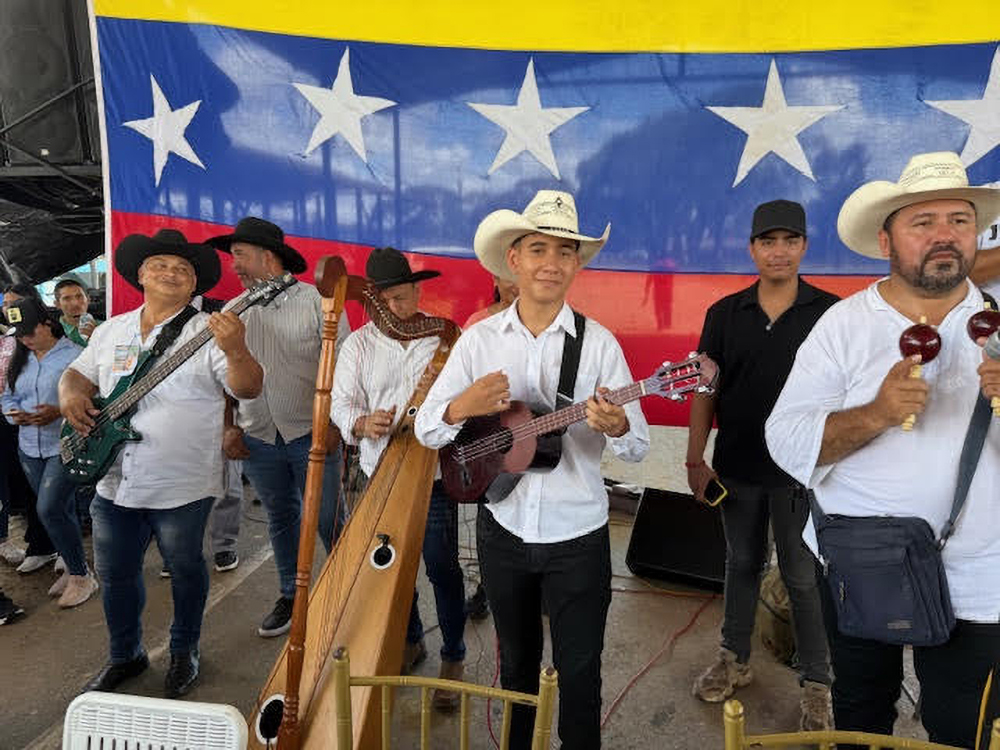
But then I started to wonder whether it was reasonable of me to take her to her music lessons inside an air base. By the way, this is a free national music program where every kid that wants to can learn music and, not only do you have access to teachers, they give you the instrument that you want.
She loves it, she’s been in this program for years and years, and now I’m thinking: Do I take her to her violin lessons or not? Is it logical for me to just stay away for a while? And how long is this going to be?
So when I decided that I wasn’t going to go, I had to talk to her about it. I said, “Listen, the U.S. is saying that they want to come in and take Maduro and have another president, and I am concerned that they may come and so let’s just wait it out for a while and we can practice at home and that sort of thing.”
And I guess it wasn’t that far of a stretch for her to understand because she is aware of all the ways that the U.S. government has affected the country. So it’s “so now they want to come in” right? That lasted for a week and a half or two and then I decided: I can’t live my life in terror. It’s like a staunch “I will live my life.”
I want everyone to be ready for whatever could come, and in that sense we need to face head-on the threats that we are receiving.
But also I don’t want people running around like a chicken without a head going, “Auuggggh, war, people—Trump is coming!” That also isn’t helpful.
What I was saying about the psychological warfare that we have won—I’m not sure how we have done that, and I bow down to the Venezuelan people for that because it’s personal for me, right: It is the reason that I took my daughter back to her violin lessons and why she’s happy playing her violin.
And we are going to have our Christmas recital, and we continue to live the lives that we have the right to live, which are happy lives, productive lives and just Venezuelan lives.
We do what we love and we infuse the tropics into everything that we do, and I’ve been thinking—the CIA must be scratching their heads, like “How do we scare these people? ’Cause we have killed their fishermen, we have stolen their boats, we have said that we’re going to close their airspace, we have shown them the largest warship in the world and…nothing, man. There is no way that we are driving these people into hysteria.”
And I’m so proud of my country for that. We are ready, we have been ready, but we will not be driven into insanity.
And I saw Maduro was singing yesterday “Don’t Worry, Be Happy,” and I realized that this is so mockable. I think it was the Daily Show that was mocking him, but, you know, “you laugh now, my friend.” What else would you have us do? Cry? Get everyone on the coast with machine guns?
We will not be driven out of our path, which is the construction of a socialist revolution, which is the construction of happiness for everyone, and which is the access to healthcare, which is access to education, which is access to music, which is access to happiness. This is what we are about.
And so, if you are going to threaten us, go ahead and threaten us. We will be prepared, but we will be prepared in “Don’t Worry, Be Happy” style.
We have come to a maturity in this revolution. We will not take our eyes off of the objective, which is the strength that Venezuela has is the history of resilience, the history of resistance against an imperialist threat.
We have been building communities to fight, for example, the impact that the sanctions have on our capacity to produce food, on our capacity to produce pharmaceuticals, on our capacity to maintain our hospitals. And so we have been fighting; you don’t catch us off guard.
It hasn’t been easy, and this is just another difficulty that you’re adding on to a people that have been strengthened by difficulty.