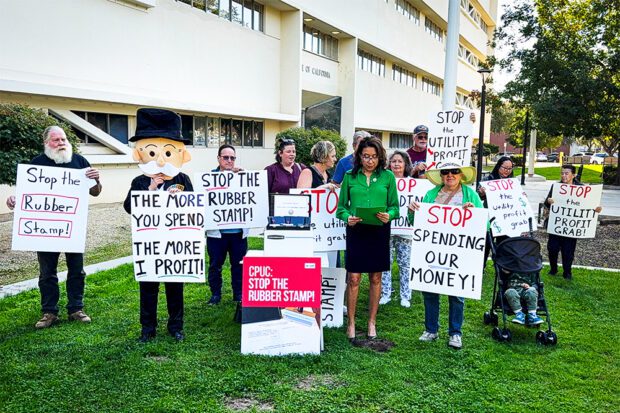
Everyone deserves safe, clean and affordable energy. But right now Fresno residents have the highest utility bills in the United States. And they’re about to get a whole lot higher.
On Nov. 7, the California Public Utilities Commission (CPUC) held hearings in Fresno to consider a request by Pacific Gas & Electric (PG&E) to raise rates significantly in the near future. There was strong community opposition, and dozens of residents rallied before the hearings, speaking out about the harms of skyrocketing utility bills.
Fresno’s bills are four times the national average, rising at a rate that far outpaces inflation. For customers of PG&E, the energy provider for Fresno, electricity bills have jumped more than 56% in the past three years, including six rate hikes in 2024 alone. The story is similar in the rest of the state.
As a result, today more than 20% of all ratepayers—nearly 8 million Californians—are behind on their bills. And in 2024 more than 317,000 households had their power shut off for nonpayment. Low-income, Black and Brown communities bear the brunt of these shutoffs, even as PG&E reported a record $2.5 billion in profits last year. Less than 3% of shareholders’ profits could have prevented all these shutoffs.
Now PG&E has asked the CPUC for another massive rate increase that will raise residential bills by an average of $42 per month—or $500 per year. The cost will likely be much higher in Fresno. By 2030, the average PG&E bill could be 14% higher than it is today.
This new rate hike would be a disastrous burden on lower-income and vulnerable communities who are already dealing with sky-high bills. It comes at a time when healthcare premiums are going up, public benefits are being cut, many workers are unable to work because of ICE raids and our communities are struggling. Most California households simply don’t have an extra $500 in the bank.
Add to all of this the specter of energy-hungry data centers coming to Fresno to power the AI bubble. If California follows trends we’ve seen around the country, our bills will likely shoot up even further, as the cost of data centers’ energy “demand” gets passed on to us, the consumers.
With climate change making every year hotter than the last, our power usage keeps going up, especially during the summer when it’s impossible to survive without air conditioning and swamp coolers. Energy is a necessity, a human right, but these perpetually rising rates show that in California, it’s treated as a privilege for those who can afford it.
Why are rates so high to begin with? The root cause lies in the profit incentives of investor-owned utilities (IOUs). The more they spend on capital assets the more profits they extract from us, the ratepayers. Unless we change that, costs will keep climbing.
People often think utilities make money by selling electricity, but they don’t. PG&E actually charges you what it pays to generate or buy the power, with no profit attached.
PG&E’s real profits come from something else entirely: building infrastructure. Under state law, investor-owned utilities earn a guaranteed rate of return—currently around 10%—on every mile of wire, every substation upgrade and every pole they add to the “rate base.” The more they build, and the more expensive the project, the more money they make—regardless of whether the infrastructure is needed.
And we are the ones who pay for both the work itself and those profits. Every dollar of return is added directly to our bills, so long as the CPUC approves the spending. That’s how PG&E walked away with record profits last year, even as families fell behind on their bills.
Everything the IOUs propose building follows the same logic: maximize capital expenditures to maximize profits. Take transmission lines, for example. A 2024 study found that publicly built lines would cost half as much as those built by IOUs because they don’t carry a profit margin. That would amount to $28 billion in savings for ratepayers—a sum that under the status quo is simply transferred from working families to utility executives, Wall Street shareholders and financiers.
The good news is sky-high rates aren’t inevitable, even in the Central Valley. Alongside the three big investor-owned utilities (PG&E, Southern California Edison and San Diego Gas & Electric), California also has many publicly owned utilities like the Sacramento Municipal Utility District (SMUD) and the Los Angeles Department of Water and Power, as well as rural electric cooperatives like Plumas-Sierra in eastern California, near Reno.
On average, publicly owned and cooperative utilities charge 50% less than the IOUs. SMUD’s rates are 58% lower than PG&E’s even though it was originally a part of PG&E.
Why such a big difference? Because they’re not-for-profit. They don’t make choices based on maximizing dividends. Every dollar goes back into operations and reliability.
Let’s be clear: As long as utilities profit by spending more, the system will keep producing unaffordable bills. You cannot regulate away the structural profit incentives that drive IOUs to overspend, overcharge and underperform. You cannot tweak an energy system that is forcing millions into poverty just so a handful of shareholders on Wall Street can get richer. It’s unconscionable, but it doesn’t have to be this way.
California desperately needs structural change to its energy system, which only the legislature can accomplish. This year, SB 332: the Investor-Owned Utilities Accountability Act, was introduced. SB 332 would have tasked University of California researchers with creating a road map for transformation: moving the state away from the profit-centered status quo toward a not-for-profit alternative that centers the needs of working families, rather than Wall Street shareholders.
The study would have considered many options—public ownership, a cooperative structure, a not-for-profit public benefit corporation—with the aim of creating a more affordable, safer and more reliable energy system.
Unfortunately, lobbyists for the utilities have succeeded in killing every viable piece of legislation that tries to take the profits out of the energy system. The insult in the injury? They use money from our own electric bills to pay those lobbyists to fight against our interests.
But the movement to transition away from PG&E and profit-driven energy is growing. For example, Reclaim Our Power is organizing across the state to transform our energy system so that it puts people and the planet over profits. In Fresno, workshops are being hosted to hear from the community about what a people’s utility could and should look like—one that works for us, not the shareholders.