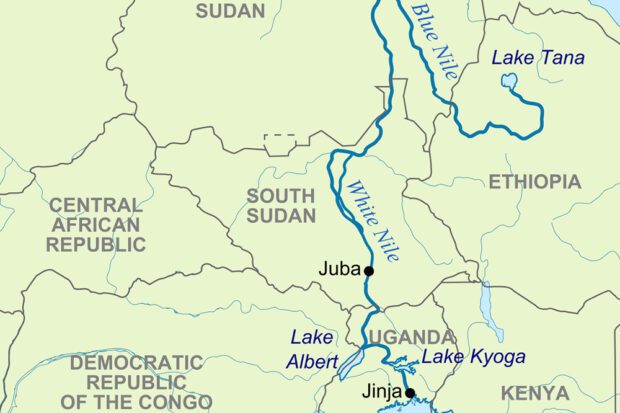
The Nile River has served as the backbone of life and civilization. Flowing through northeastern Africa, the Nile River is the longest river in the world, spanning approximately 6,650 to 6,850 kilometers (4,132 to 4,258 miles).
Originating near the Equator, it travels northward across 11 countries before emptying into the Mediterranean Sea. For thousands of years, its fertile banks and seasonal flooding have sustained agriculture and human civilizations along its course.
Today, it remains an indispensable resource for the countries it flows through—primarily Egypt, Sudan and Ethiopia. As rainfall becomes increasingly unpredictable and agriculture remains central to local economies, the Nile has become more than a river; it is a symbol of survival, political power and economic potential.
However, the way its waters are distributed is steeped in historical agreements that favor downstream countries—particularly Egypt—leaving upstream nations at a disadvantage. This imbalance has led to rising tensions among riparian states.
As climate change, population growth and resource scarcity worsen, cooperation among Nile Basin countries is not only necessary but also urgent.
Recent tensions between Egypt and Ethiopia over the Grand Ethiopian Renaissance Dam (GERD) have intensified, with Egypt accusing Ethiopia of exacerbating recent flooding through unilateral dam operations. Egyptian President Abdel Fattah el-Sisi has called for international intervention and a legally binding agreement to regulate the dam’s use.
Ethiopia, however, insists it is operating the dam responsibly and accuses Egypt of maintaining a “colonial-era mindset” that hinders regional cooperation. The dispute remains unresolved, with both sides blaming each other for escalating the crisis and undermining mutual trust.
Echoes of the Past: Rising Tensions Today
The geography of the Nile Basin is complex, spanning 10 countries with varying degrees of dependency on the river. For countries such as Ethiopia, Uganda, Rwanda and Sudan, the Nile flows through substantial portions of their territories.
In contrast, Egypt, though almost entirely reliant on the Nile for freshwater, contributes little to its flow. More than 97% of Egypt’s irrigation water comes from the Nile, while most of its sources lie upstream—in nations that have historically had limited access to its use.
The foundation of this unequal usage lies in colonial-era treaties. The 1929 agreement between Egypt and Britain granted Egypt veto power over any upstream water projects.
Later, the 1959 bilateral agreement between Egypt and Sudan divided the Nile’s total flow between the two countries, allocating 55.5 billion cubic meters to Egypt and 18.5 billion to Sudan, leaving no allocation for upstream states like Ethiopia, Kenya or Uganda. These nations were not only excluded from the negotiation process but also prevented (via treaties) from using even a drop of the Nile’s water without downstream approval.
Projects like Egypt’s High Aswan Dam and the unfinished Jonglei Canal were launched to cement Egyptian control over the river. Although these projects stabilized Egypt’s water supply and energy generation, they also symbolized the country’s unwillingness to share resources.
Ethiopia, for instance, was explicitly targeted through diplomatic and economic pressure to halt any development plans involving the Blue Nile. Egypt strongly opposed Tanzania’s plan to build a pipeline from Lake Victoria and warned Kenya against withdrawing from the colonial treaties, calling such actions a violation of international law and even an act of aggression.
The reaction from upstream nations has grown stronger over time. Many reject the colonial agreements, arguing that they were imposed without consent and do not reflect modern-day needs.
Ethiopia, in particular, has become more assertive in developing the GERD to address its own water and energy challenges. The dam was officially inaugurated on Sept. 9, after its completion in July. Situated on the Blue Nile, it is the largest hydroelectric dam in Africa, with a capacity of 5.15 gigawatts, aimed at meeting Ethiopia’s domestic energy needs and supporting electricity exports.
Although Ethiopia views the project as a catalyst for regional development, the dam’s launch has intensified tensions—particularly with Egypt, which remains concerned about potential impacts on its water security. Egypt continues to view such projects as existential threats, reinforcing a “zero-sum” mindset in which any gain for upstream countries is seen as a loss for Egypt.
Strengthening Regional Ties to Tackle Mutual Issues
While tensions continue to simmer, the broader reality is that all Nile Basin countries face similar developmental challenges: food insecurity, energy shortages, growing populations and environmental degradation. These shared struggles should serve as a basis for cooperation rather than a source of conflict.
Regional initiatives, such as the Nile Basin Initiative (NBI), and international principles, including the Helsinki Rules, promote the equitable and reasonable use of transboundary water resources. These frameworks promote mutual respect, shared benefits and collaborative management of water resources. However, progress has been slow due to mistrust, lack of enforcement mechanisms and unilateral actions that undermine collaboration.
In addition, environmental threats—such as desertification, deforestation and drought—affect the entire region. As the Sahara Desert expands southward, fertile lands are lost, and communities are forced to relocate. Only through basin-wide planning, improved water harvesting and sustainable land-use practices can these challenges be effectively addressed.
From Policy to Partnership: Keys to Regional Progress
Despite strong declarations from global institutions, Africa remains plagued by poverty, underdevelopment and lack of infrastructure. These problems are intensified in regions like the Nile Basin, where water scarcity limits agricultural productivity and hinders economic growth. To reverse this trend, political will and international cooperation are critical.
All riparian states must work toward establishing a legal and institutional framework that ensures fair water allocation and protects the rights of both upstream and downstream users. These frameworks should include mechanisms for dispute resolution, capacity building, technical training and the development of joint water projects. Such collaboration would not only reduce tensions but also promote economic integration and regional stability.
Egypt’s current strategy—based on maintaining dominance and opposing upstream development—is no longer sustainable. Geopolitical shifts and the declining influence of external allies, such as the United States, mean that Egypt must adapt.
A cooperative and inclusive approach would enable Egypt to secure its water needs while supporting the development of its neighbors, while, on the other hand, continuing to oppose equitable water-sharing risks regional instability, potential conflict and the loss of international goodwill.
Policy Recommendations
The Nile Basin countries stand at a pivotal crossroads. They can either persist with unilateral actions and reliance on outdated agreements, risking further conflict, or choose a path of collaboration to secure long-term water sustainability and regional stability. With the region’s population projected to rise from more than 400 million today to more than 556 million by 2050, the decisions made now will shape the future well-being and prosperity of generations to come.
To move forward, three major steps are essential:
- Reject outdated colonial treaties and negotiate a new, basin-wide water-sharing agreement based on international legal principles, such as the Helsinki Rules.
- Prioritize joint development projects in irrigation, hydropower and flood management that benefit both upstream and downstream states.
- Build strong institutions and leadership, supported by international partners, to promote transparency, accountability and sustainability.
Water is not just vital for life; it also serves as a cornerstone for peace and sustainable development. With mutual respect, strong political will and visionary leadership, the Nile River has the potential to transform from a source of conflict into a unifying lifeline for all the nations that share its banks.