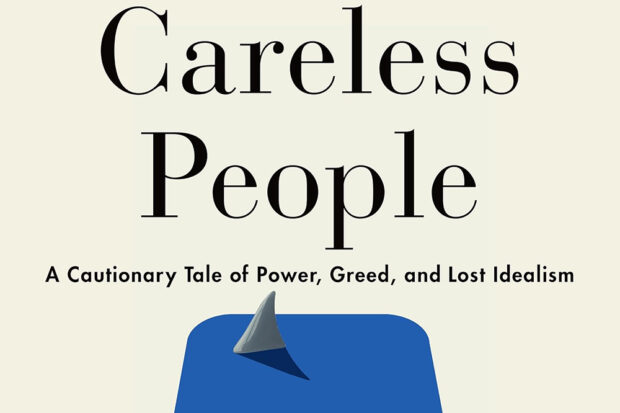
The journey that Sarah Wynn-Williams traces in Careless People began when she came down with a severe fever—Facebook fever.
In 2006, she noticed that politicians were starting to use the platform—and that thrilled and inspired her. This tool, she sensed, had the potential to change political discourse for the better.
Also fueling her enthusiasm was the role that Facebook played in the wake of the 2011 earthquake in Christchurch, New Zealand. Regular media sites were down, but Facebook filled that vacuum. It let people tell family members where they were; it helped to get the word out about things like road closures.
She was so fired up that sitting on the sidelines wasn’t an option.
When she sought employment at Facebook, she pitched a suggestion for a position that didn’t even exist there yet—one that she felt she could handle, given her work experience at the United Nations.
Eventually, she landed that new post: Manager of Global Policy.
Over time, however, her Facebook fever subsided and then vanished. She increasingly came to recognize how naïve she’d been.
At the end, after an action-packed seven-year stint, she left the firm.
Three watershed moments especially fueled her growing disenchantment with the company’s culture, aspirations and business practices.
First among them: a business trip to South Korea in 2014.
Facebook was now growing faster in Asia than in other areas, and management decided to present a show of force there.
Mark Zuckerberg would go along, as well as all of the members of his MM-Team—Facebook’s top managers.
But one problem bedeviled planning for the trip. South Korean authorities had begun criminal investigations of Facebook’s top brass, and they’d issued arrest warrants for Zuckerberg, Sheryl Sandberg and several others.
A South Korean agency that monitored overseas gaming had contacted Facebook and asked them to share all of the games available on the site so that they could be assessed. According to South Korean law, Facebook needed to comply.
When the company failed to respond, the Cybercrime Branch of the Seoul Police became involved.
But Facebook had a cavalier stance about the issue. The company felt that no South Korean entity could force them to do anything.
By that time, other nations—including Brazil, India and France—had also initiated Facebook investigations. The company felt the same way about those cases.
During one company meeting, Wynn-Williams proposed that they cooperate with the South Korean demands and do the same in all countries where they operated.
That suggestion found no support.
Instead, the top executives considered a plan to determine how earnest the South Koreans were about enforcing their laws.
They could allow one of their employees to be arrested there. Wynn-Williams, who had the least seniority in the room, was selected to be “the body” for this tactic.
Later, though, they dropped that plan, deciding that her presence was needed to prepare for the trip and help to make it a success.
That incident showed her how little regard Facebook’s leadership had for her, despite her onerous workload. She now sensed that it might be better to work elsewhere down the line.
Another watershed moment for Wynn-Williams involved Zuckerberg’s relentless quest to enter the Chinese market, regardless of the cost. Given the financial realities, his passion is understandable. In 2017, when Facebook was still forbidden in China, the company raked in $5 billion in advertising from Chinese businesses.
How did Zuckerberg plan to breach the Great Wall that the Chinese had set up? According to Wynn-Williams’ retelling, the plan was to cater to that country’s every desire and whim.
In one set of documents that she came across, Facebook promised to “promote safe and secure social order”—meaning that it would facilitate the Chinese government’s surveillance of its citizens. After all, the document stated, “[W]e adhere to local laws wherever we operate and develop close relationships with law enforcement and governments.”
Facebook earmarked millions of dollars to bankroll their effort. Some of that money went to organizations that would approve of its wish to enter China and thus blunt critical voices from the6likes of Human Rights Watch and Reporters Without Borders.
Another part of the company’s strategy was to keep U.S. authorities in the dark about the precise nature of its campaign.
Facebook had no qualms about deceiving members of Congress about their methods. A team was established in the firm to help Zuckerberg to prepare for his testimony on the Hill.
One piece of advice that the team offered: Zuckerberg should not disclose that Facebook had cooperated with the Chinese Communist Party to put together censorship software.
Zuckerberg’s talking points were intended to shield such practices from discovery. Senators would have to pose exceedingly specific questions to uncover such information, and that was unlikely.
Yet another turning point for Wynn-Williams happened in 2016, when she discovered how much Facebook had done to support the Trump presidential bid.
The firm, for example, placed some of its employees inside the Trump campaign for several months. Brad Parscale, who headed the operation they were involved in, oversaw efforts to target voters with strategically selected misinformation, incendiary posts and fundraising appeals.
Parscale also used Facebook to mount an array of voter suppression efforts.
When it came to advertising on the social media site, the Trump campaign outspent the Clinton side by a wide margin.
During the weeks leading up to the election, the Trump camp was among the top advertisers on Facebook globally. Facebook was also the Trump campaign’s largest wellspring of contributions, garnering millions of dollars per month.
Although packed with thought-provoking anecdotes and insights, Careless People hardly provides an exhaustive look at Facebook’s ethically dubious practices.
Augmenting her work are Jonathan Haidt’s findings in The Anxious Generation, in which he examines the deleterious effects that social media have often had on young people.
To show how Facebook aimed to get teenagers hooked on its platform, Haidt draws on portions of the Facebook Files—company materials that whistleblower Francis Haugen revealed four years ago.
In one part of the Files, three Facebook employees give a presentation “to support [the] Facebook Inc.-wide product strategy for engaging young users.” They draw on scientific findings about the brain’s gradual maturation during puberty, and they note that the frontal cortex isn’t mature until people are older than 20.
As they put it, teenagers “are highly dependent on their temporal lobe where emotions, memory and learning, and the reward system, reign supreme.”
They then provided guidelines on how to keep those users on the platform for greater lengths of time. For example, adolescents could be nudged to set up multiple accounts, and “stronger paths to related interest content” could be implemented.
Other sections of the presentation make it clear that the speakers had no concern about the dangers of overuse and addiction among young users.
The website of Meta, as Zuckerberg’s company is now called, foregrounds a set of the firm’s principles. Included are pledges to “give people a voice,” “build connection and community,” and “keep people safe and protect privacy.”
Their actual track record, as shown in Careless People and elsewhere, is far less impressive.