In what was supposed to be a ritual start of a new year, the Fresno County Board of Supervisors’ first meeting of 2026 on Jan. 6 was notable for feeling like the last. Resignations were announced, and goodbye speeches flowed despite the long year yet looming ahead.
The annual “designation of officers,” a musical-chairs shuffling of seats, left District 2 Supervisor Garry Bredefeld chair, replacing District 4 Supervisor Buddy Mendes, subtitled “Making Offers You Can’t Refuse.” District 1 Supervisor Brian Pacheco declined the vice chair position, which went to District 3 Supervisor Luis Chavez.
Outgoing chair Mendes announced his retirement from the Board, effective at the end of this year, followed by pomp and speeches—despite which, again, he still has a full year to go. Bredefeld lauded him, called him a “mentor,” presented him with a souvenir gavel and a joke portrait, and Mendes’ chief of staff, Vickie Day, read a humorous ode to Mendes, which she composed herself.
District 5 Supervisor Nathan Magsig praised Mendes in terms bordering on eulogy: “Buddy,” gushed Magsig, had a heart “as big as this room,” recent complaints about inadequate meeting-room size notwithstanding.
In fact, Mendes has repeatedly demonstrated his short fuse, impatience, self-absorption, regressive sense of humor, intolerance, explosive temper and impulsivity. Some of these behaviors were acknowledged but made light of in Day’s poem.
Chavez typically disarms the pretensions of both Mendes and Bredefeld with jabs of ironic humor; Chavez jestingly addressed Bredefeld as “your highness,” alluding to his ascent to the chair position.
Then to the irascible Mendes he quipped that, when they were first introduced, he had to look up the word “bloviator” as well as the juvenile, faux-scientific term, “recto-cranium inversion,” of which Mendes is fond of deploying, typically against the state government, and which reflects his scatological fixation as well as his fusing of aggression and exhibitionism with a fantasy of authenticity.
Pacheco noted that 2026 would be his last year with the Board because he is a candidate for State Assembly District 27. He noted that with two Board members leaving, and possibly a third—Magsig is a candidate for State Senate District 12—it was in the interest of the Board for him to decline the vice chair position.
He pointed out to Mendes that they “came in together,” both having served since 2015, and “as fate would have it,” will leave together, quipping “heaven help us” because the “two ‘city’ guys” (Bredefeld and Chavez both served on the Fresno City Council) would now be leading the county.
It’s better “to go out on one’s own terms,” Pacheco concluded, pointing out to Mendes that today was “our last first day.”
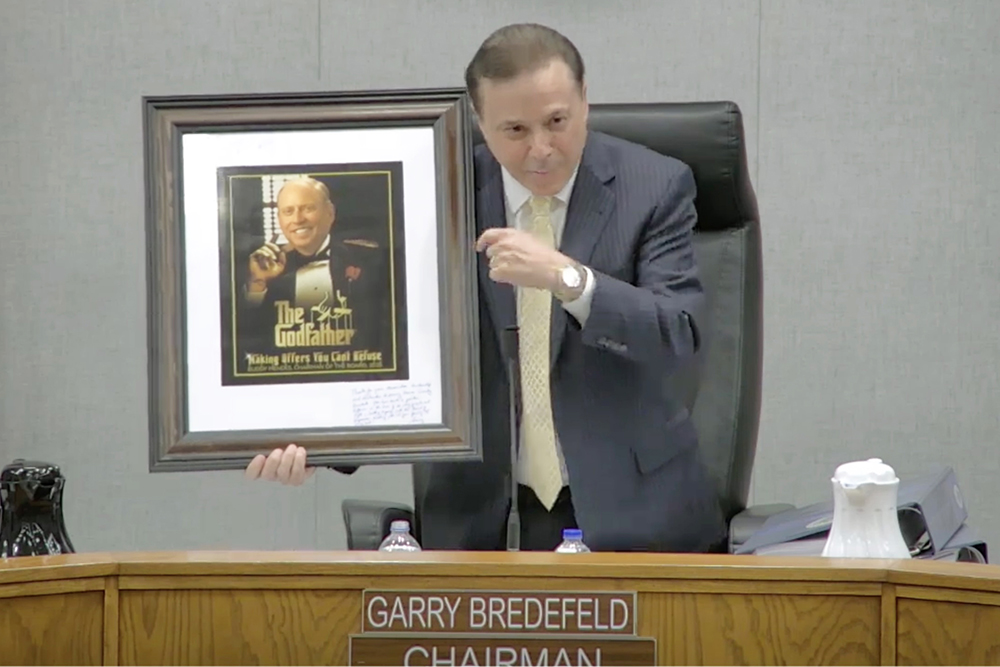
portrait of outgoing chair Buddy Mendes. Screenshot from livestream
Sex Offenders in Transitional Housing
After a contentious debate, with members of the public present to argue both pro and con, the Board, with a 5-0 vote, formally approved an ordinance limiting the number of paroled sex offenders residing in the same transitional-housing unit to six.
A first hearing on Dec. 9, 2025, had been approved, and the second hearing of the item was pulled for discussion from the consent agenda by a member of the public.
Twelve people were present to make heartfelt arguments, half for each side. Dawn Coyle, co-owner with her husband John of Centers for Living transitional homes, wore a large crucifix around her neck. She asked the Board to defer a vote on the ordinance until a contingency plan could be made to allow time to plan for alternative housing for those displaced by the limit on the number of residents.
Others who opposed the ordinance cited biblical passages that bolstered their points of view, and a couple of commenters said they had become ministers during the course of their stays in transitional housing, some of which entail evangelical Christian instruction.
“What would Jesus say?” asked one, pleading with the Board not to pass the ordinance, which would “punish people for who they used to be.”
Others agreed with Coyle that the ordinance would cause more homelessness, leaving paroled sex offenders with nowhere to go, wandering at large.
Another laid bare that he was a “dreaded sex offender” a couple of years out of prison and credited Centers for Living for his recovery; he was “very conservative,” voted for Trump and “probably for you, Bredefeld.”
On the supporting side, people who live in neighborhoods where transitional homes are located said that residents of the homes “stare them down” and sit in front of their houses “for hours.” They made claims about thefts that they felt were perpetrated by the parolees.
Others said that the properties were poorly maintained, that “trash was piled up” and made vague claims such as that parolees “walk by our homes all the time” and that the operators of the transitional homes were “only in it for the money.” Bredefeld, now chairing the meeting, permitted unrestrained applause after each speaker.
Magsig made a point of thanking everyone for speaking and singled out the “brave” Trump-supporting parolee for “sharing your heart.” Citing the several biblical references made by commenters, Magsig, unable to resist boasting of his vast Bible knowledge, let everyone know that “scripture was not black and white” on this issue.
Coyle earlier had said that they had followed state law in permitting one resident per 250 square feet. Remarkably, only at this point did a member of the Board think to consult a legal authority. “What is the state law?” Magsig asked County Counsel Doug Sloan, who replied that there were two issues: building codes and zoning.
Per state building code, one person is allowed for every 250 square feet. Per state zoning law, up to six unrelated people may live in a single-family dwelling. Magsig then diverged into more Bible talk, as religion is one of his fixations—he was the authority on the Bible, and no matter what passage anyone else cited, he would have the last word, using the passages he preferred (the book of Titus) to reach a decision: He stretched this Biblical allusion to conclude that “systems [e.g., plumbing] should not be overburdened.”
Pacheco remarked that there was “no question” that the Coyles were trying to help people, but the concern was the concentration of sex offenders and public safety. If everyone was “doing it right,” there shouldn’t be an issue, he said.
Then he asked Sloan to clarify his remarks about state law as it affected this ordinance. Sloan explained that per current state law, local jurisdictions may (not “must”) make regulations regarding a single-family house with more than six unrelated occupants, which appeared to satisfy Pacheco.
Chavez remarked that he “didn’t like the undertones” of vilification toward the Coyles reflected in some of the commenters’ remarks; however, he, as a foster parent, “didn’t trust the hearts of men who have done unspeakable things to children.”
Bredefeld, as chair now speaking last, nevertheless didn’t miss an opportunity to demonstrate his oft-expressed hostility toward the state government, which he called “pro-criminal,” and his mulish refusal to engage in a reasonable manner: “I don’t care what they say, state law is stupid!”
Measure C: Bredefeld’s Vow a Success?
During the portion of the meeting reserved for supervisor committee reports and general comments, the focus was on Measure C, the sales tax that funds the County’s transportation projects, and which is scheduled to appear on the November 2026 ballot for a renewal vote.
Ongoing negotiations by a steering committee for how to budget the tax revenue have been contentious, mainly because of vociferous opposition by a minority—led by Bredefeld and Mendes—to funding such areas as public transportation; they prefer 30 years (the term of the measure) of repeatedly fixing potholes and building more roads for cars.
Chavez remarked that he met with Measure C “folks”—presumably members of the steering committee—who, having recently approved the spending implementation plan by a 10-4 vote, asked that the current proposal be placed on the Board’s agenda. However, Chavez noted that, historically, the 15 cities of Fresno County have a chance to weigh in first, something he appeared to prefer in this case as well.
He urged “folks” who anticipated a competing initiative (which would require a complex petition process to appear on the ballot) to consider compromising and discussed what things might look like without a Measure C—the loss of Measure C funding would entail layoffs and significant loss of money for any of the County’s transportation-related projects, Chavez warned.
It must appear on the agenda so the Board can vote on it, as they have the final vote in the process—if it is not agendized, the Board can’t vote on it, and if they don’t vote on it, it won’t appear on the ballot in November. Hence, there is a possibility of a competing measure in the form of a ballot initiative.
Mendes commented that this was his 12th year dealing with Measure C, and he reiterated Chavez’s point about cities voting on the updated measure before the Board votes. He didn’t hide his petulance over not getting his way on the terms of the updated measure, claiming without evidence that there was “lots of dishonesty” in the process.
“Electeds have the final call! Others can say what they want, but electeds have the final call!” By “electeds,” he appeared to mean himself and other Board members, not elected members of any of the 15 city councils within the county, and rather than the “final” call, he appeared to be affronted that his was not the “only” call.
Bredefeld picked up where Mendes left off and reiterated his favorite canards about Measure C: The steering committee was “hijacked by radicals,” they want to “get people out of their cars,” “nobody wants
bikes,” it was a “shit-show,” they support “climate change nonsense” and so on.
“I told them ‘No’ in no uncertain terms!” he ranted. Bredefeld’s oft-repeated threat about Measure C—“I’ll make sure this fails!”—loomed like a promise to burn the house down if he couldn’t run it.
Addendum: Days after the Jan. 6 Board meeting, reports confirmed that Measure C is at an impasse, and if a citizens’ initiative reflecting a holistic approach to the next 30 years of transportation funding and development (e.g., one that entails public transit) is to appear on the November ballot, supporters must act quickly. Bredefeld’s vow to “make sure it fails” appears to have been effective.