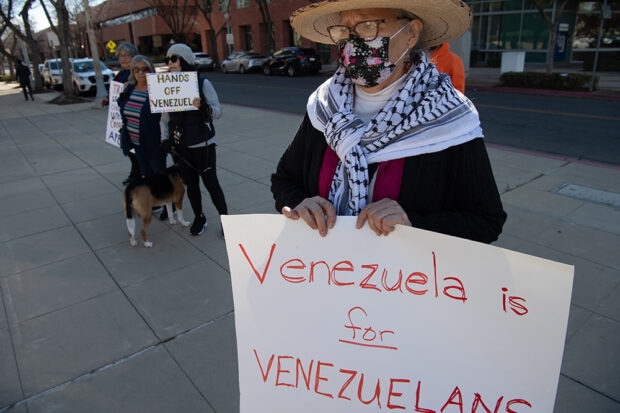
(Editor’s note: The narrative below is excerpted from a phone conversation between Giselle (who wanted her last name withheld), a resident of Venezuela, and Leni Villagomez Reeves, a Community Alliance reporter.)
I guess I’ll start from the beginning if I know where the beginning would be: I guess it would be [former Venezuelan president Hugo] Chávez getting into power and the U.S. starting its campaign against Venezuela in all regards: the information campaign against us and then the unilateral economic coercive measures that affected our lives and are still affecting our lives. And then the threat of military violence, which is difficult because you don’t want to go into a state of panic—that’s part of the idea there: not only to blow up our stuff but to mess with your head.
I think Venezuelans have been resisting so many different types of attacks. It seems like we’re impervious to the concept of more threats: We just continue to live our lives. We were prepared in the sense that we could have imperishable goods stored at home and that sort of thing, but life continued as it usually did, so people took their kids to school, they worked and then…
I live five minutes away from an air base. I’m a single mom, and I live with my kid and with my mother who is 74 years old. We were asleep and the windows started rattling and—it’s hard to relate this—you could hear the sound of what I now know to be bombs, which is a sound like—it goes (high pitched noise) and the windows rattle and you know what’s happening, but you don’t know what you can do.
And so I live on top of a hill and my house has a roof that you can climb on and look at Caracas, and I could see the smoke. I couldn’t see the planes, but I could hear them and I could see the explosions.
So I go to my daughter’s room and she isn’t waking up—she’s a very heavy sleeper—and what you could hear mostly were the rattling of the windows over and over. So you don’t know what to do.
What can you do? I went and filled up water, drinking water, just filled up any pot I could with drinking water because I didn’t know what was going to happen. I’m pretty sure my mom had gotten awake, and she didn’t understand. She thought it was fireworks because she just…it’s unfathomable, you know?
The Revolution constructed millions of houses, free housing for low-income people around the country. You don’t need to believe the stats, you just need to go around and you can see.
My daughter’s godparents live there inside Fuerte Tiuna, which was one of the most heavily struck air bases and so [I was] thinking of them and whether they’re alive or not.
There are—I don’t know how many residential buildings inside that air base. I write them: “Are you okay? You should come here.”
And I get a response from them, I get an audio message saying “We’re alive, we’re doing well, I can hear a plane, I can hear a plane and that it’s coming…” Jesus Christ. It’s just unfathomable.
And then my mother wakes up in the morning and my daughter, and I don’t want to tell her. What do you tell a child, an eight-year-old child? You don’t know what’s going to happen.
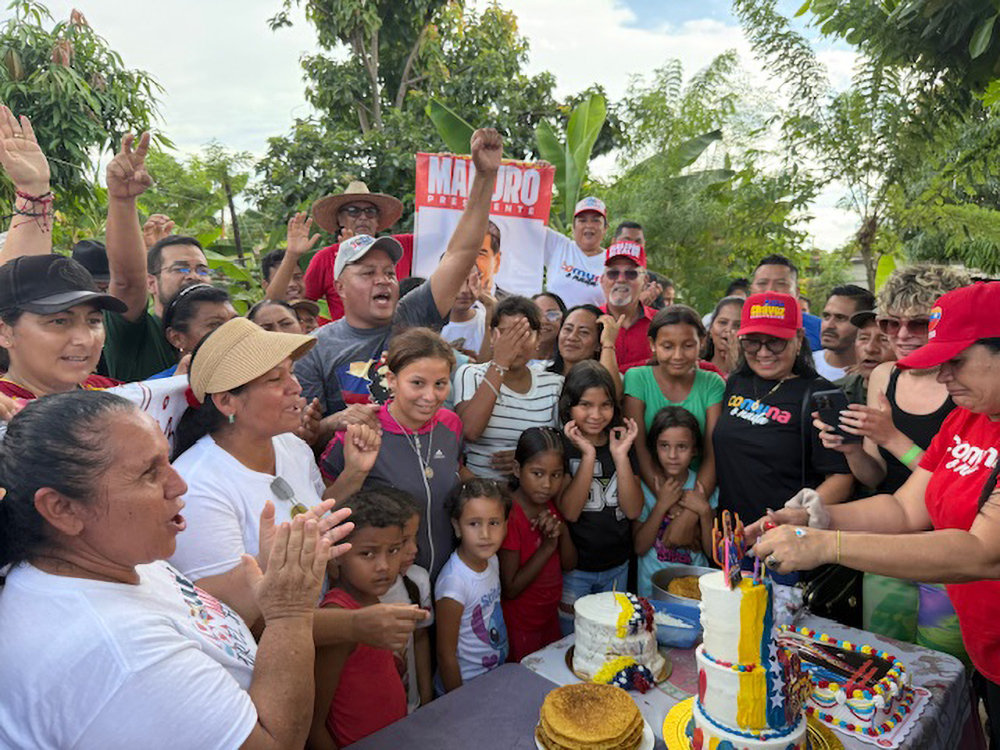
No matter how scared I am of the bombs, I’m more scared of a right-wing dictatorship that can come. And at that moment you don’t know. You hear the bombs and then we start listening and hear the rumors about Maduro being taken and you don’t know what to expect.
You start communicating. I’m part of a collective, and there are people in different parts of Caracas and everyone described what they heard, what was happening, whether they were okay or not, whether they had been struck or not.
Trying to find a way to tell my mother.
Finally, I got a message from my daughter’s godparents, they were fine, were alive, and they needed to come to my house. So I tell my daughter that they are coming and she’s so excited.
She starts getting a room ready for them. “This is where my godfather’s going to go, and this is where my godmother’s going to go.” She’s so sweet, and she wanted to see her godparents.
They finally arrived, and my daughter’s got this immense smile on her face and her godmother’s eyes[showed she was]crying so much and they could barely put on a smile. And I told them, “You know, she doesn’t know about the bombings. Please don’t tell her. It’s too much.”
But how can you ask [that of] someone who’s been bombed, whose house may or may not be there when they go back—if they go back…
And so they get out of the car and they’re just heartbroken and scared and wanting to share the most horrible experience of their lives with someone that they love, but they can’t because there’s a child.
They brought their passports; they brought their academic titles because that’s the sensation, right, of fleeing. You don’t know what’s going to happen, you don’t know if we’re in danger, you don’t know what the future holds. We have our passports and our titles—the feeling that that implies…Jesus.
They hadn’t eaten, they hadn’t slept, they were traumatized by the sound of helicopters and planes and bombs and machine gun fire and what they saw and what they heard, and they didn’t have any information.
They didn’t know that [Venezuelan vice president] Delcy [Rodriguez] had us in power; they didn’t know that the government was in place and so they felt “the Revolution is gone, we need to flee.”
So I hugged them, and I told them, “We’re still in power. Everything isn’t lost. There’s solidarity outside of Venezuela.” I fed them. I gave them a place to sleep, to take a shower, get some rest [and] Internet, so they could know what’s going on.
Their descriptions—just awful—seeing the size of the helicopters. What can you do against something like that?
They have taken down our anti-aircraft systems.
We are naked.
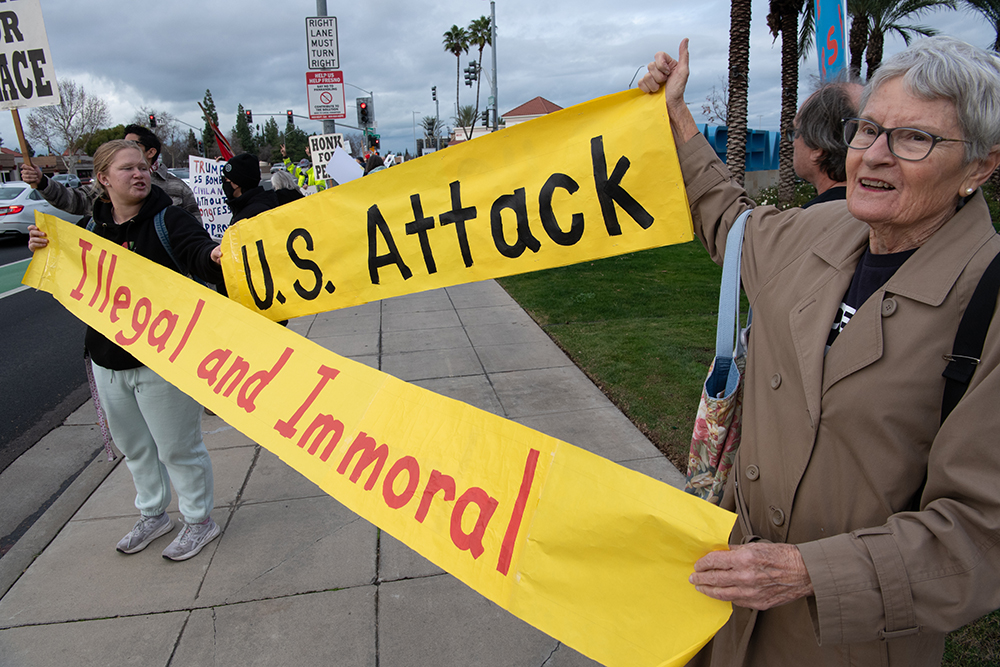
And we don’t have our president. We still hold power, and we still hold power and dignity in our plans, in our thoughts and our principles, but you have to negotiate when you are in that state of complete vulnerability. They’ve taken down our military defense systems. They’ve shown that they do whatever it is that they want.
I really trust Delcy (now the acting president) and her brother (Jorge Rodriguez, president of the National Assembly of Venezuela) to do well in that because they are strong, experienced politicians that won’t give us up for nothing, so it’s just…let’s see what happens now.
Trust in the government and trust in our people, really. ’Cause it was obvious to me that you didn’t take down the Revolution by taking down Maduro. You would need to do a hell of a lot more than take out our president because then there’s a vice president, and then there’s an entire government, congress, and there’s an entire people.
So that’s what gives me some sort of calm, is knowing that they don’t have the Venezuelan people; they don’t have our complicity.
I love this country. I am a socialist at heart. This is where I feel I need to be. This is where I want to be. We want to construct something so wonderful and so just. We want to be an example for Latin America and the world.
*****
Giselle has a Ph.D. in climate change ecology and works in an organic farm collective.