Californians for Pesticide Reform has launched an assault on the state’s regulation of agricultural fumigants 1,3-dichloropropene (1,3-D) and chloropicrin, calling on the Department of Pesticide Regulation (DPR) to issue stronger guidelines for the use of these extremely toxic chemicals, especially near schools and nearby farming communities.
Advocates for public health and farmworker safety gathered last month in Watsonville, Modesto, Oxnard and Fresno to protest the state’s recently issued rules at events that were livestreamed statewide.
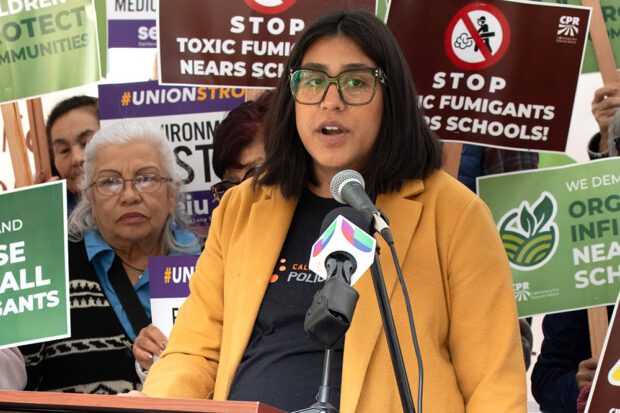
Gabriela Facio of Sierra Club California kicked off the events with an overview of the problem at hand. “Our communities are more than alarmed about the weak regulation of 1,3-D recently finalized by the Department of Pesticide Regulation.”
She described the product as a “cancer-causing, lung-harming toxic air contaminant and a volatile organic compound fumigant that most of the world finds so dangerous it has been banned in 40 countries.”
But in California, Facio stressed, “DPR has not only refused to ban 1,3-D, but has refused to follow the findings of the state’s own cancer experts at the Office of Environmental Health Hazard Assessment in setting the allowable exposure targets of its new regulations.”
Facio charged that the regulation allows schoolchildren to be exposed to 14 times more of the pesticide than the cancer risk threshold level established by the state toxicologist.
“California has created an environmentally racist regulation that sacrifices Latino and indigenous kids,” she said.
These products are marketed under common trade names Telone, Dedisol C and Vorlex, and are widely used to kill microorganisms that live in the soil, such as nematodes, in Central Coast strawberry fields and in San Joaquin Valley vineyards and almond orchards.
Although farmers depend on these chemicals to maintain productivity, their widespread application poses a health danger to farmworkers working in the fields and in neighboring farming towns. The U.S. Department of Health and Human Services has determined that 1,3-D is a probable human carcinogen.
How dangerous is it? Exposure can cause skin irritation and respiratory stress.
According to the National Library of Medicine, “Short-term exposure to a certain concentration of 1,3-D is harmful to the human body in a closed environment.
“Absorption through the respiratory tract may be followed by passage across the blood-brain barrier, deposition in the brain tissue, then inhibit the central nervous system and cause diffuse brain tissue edema, leading to acute damage to heart, lung and kidney function, and eventually leading to death.”
In 2023, a man working in a greenhouse in China died from 1,3-D exposure.
Chloropicrin is another universally applied fungicide and insecticide. It’s known commonly as tear gas and is sold under several brand names including Tri-Chlor and Larvacide.
Chloropicrin is a toxic irritant that can cause severe respiratory damage, eye irritation and skin burns. It is often applied in combination with 1,3-D products as a fungicide. Historically, it has been and continues to be used as a chemical warfare and crowd control agent.
At the Watsonville protest, Salinas elementary school teacher Oscar Ramos said his job is to protect his students, and he pulled no punches. “Our schoolchildren are required to go to school where they’re exposed to highly hazardous pesticides. Let’s call it what it is, they are being poisoned.
“While the rest of the world has been banning fumigants like 1,3-D and chloropicrin in the past decade, California regulators have allowed more and more fumigants to be used near our schoolchildren. Anyone with a heart, a conscience or a soul knows that’s just plain wrong on so many levels.”
Facio stated that in 2014 the California Department of Public Health published a first of its kind study on the use of highly hazardous pesticides within one-quarter mile of public schools in the 15 counties with the highest pesticide use.
“What we found is an alarming overall increase in these 15 counties,” she noted. “1,3-D use climbed from over 149,000 pounds to nearly 190,000 pounds, a 27% increase.
“The other toxic fumigant, chloropicrin, is among the most heavily used synthetic pesticides in the state. It is a lung-damaging agent, and its use grew from 161,000 pounds to 259,000 pounds within one-quarter mile of California schools. That is a 61% increase altogether.
“The combined use of these two fumigants increased 45% between 2010 and 2022.”
In Modesto, Dr. Michelle Ryan, a family nurse practitioner and public health expert, emphasized that children are the most vulnerable to poisoning.
“As healthcare providers, we constantly remind parents to keep cleaning products, medications and poisons safely locked away out of reach of children,” states Dr. Ryan. “And we do this because children are curious and because, unfortunately, they like to put things in their mouth.
“So why then at the same time, can we be okay with intentionally placing poisons on the very food they eat, right in the soil where they live, and in the air around their schools and playgrounds?”
Dr. Ryan underscored that children are not miniature adults. “Their brains, lungs and immune systems are still developing. They breathe faster and take in more air, and their body surface area is larger, allowing for increased absorption through their skin. All of this increases their risk of taking in more toxins when they are exposed.
“They also spend more time near the ground where pesticide residues accumulate and may play on grass contaminated by pesticides, [as] volatilization drift from nearby fields where pesticides were used just the night before.
“And for children living or going to school near treated fields, exposure is not a one-time event. It is daily cumulative and lifelong, beginning even before birth in the womb.
“Exposure to pesticides like 1,3-D have been linked to increased risks of cancer, brain and nervous system disorders, and respiratory diseases including asthma and gastro-intestinal and kidney disorders.”
John Mataka is a community advocate who works closely with residents impacted by pollution and environmental hazards across Stanislaus County. He insisted that school districts cannot wait for the state to do something.
“The Department of Pesticide Regulation has shown that it will compromise community health,” says Mataka. “State-level protections remain weak and scientifically outdated.
“Counties, cities and school districts have the authority to go beyond the state minimum requirement. Waiting for Sacramento to do something is accepting continued harm to our residents and our children.
“We demand a one-mile buffer. That is supported by low-income communities. It is supported by evidence, science and community experience. Anything less is knowingly exposing our children and our residents to health issues and harm.”
In Fresno, Rocio Madrigal, a community organizer with the Central California Environmental Justice Network, said that the new proposed rule is a racist regulation that sacrifices Latino communities.
“In a current pesticide monitoring study CCEJN has conducted in West Park and other areas of south Fresno, 1,3-D has been detected in a monitor that was placed inside of West Park Elementary,” said Madrigal.
“The pesticide was detected even when there are no close-by permitted applications. West Park is home to a school where 90% of the students are Latino.
“It is also home to Latino elders who spend hours outdoors taking care of the yards, sometimes after decades of being farm laborers and being exposed at their place of work.”
Facio called into question the state’s regulatory policy. “If the individual pesticide regulation process can give us the unscientific and racist policy we have now with 1,3-D, then the whole process is broken.
“Our attorney friends are already working on a legal challenge. But the problem is not just 1,3-D, it is the entire class of highly drift prone and highly hazardous fumigants.”
Speaking on behalf of the coalition of advocate organizations, Facio issued a demand for immediate action. “We call on the state and specifically DPR to phase out fumigants entirely.
“In the meantime, our county ag commissioners must step up to protect our kids. The buffer zones have not been big enough to reduce fumigant exposure from extremely high levels.
“We call for the expansion of buffer zones from the current one-quarter mile to at least one full mile around schools and daycares.
“Finally, we call on ag commissioners and DPR to get together to fund and implement pilot projects to infill school buffer zones with organic farming.”
Farming Communities Protest Fumigant Regulations
BY CRISTINA GUTIERREZ
Across California, farmworker communities are sounding the alarm: The state’s regulation of the cancer-causing fumigant 1,3-dichloropropene (1,3-D, brand name Telone) is not only dangerously unscientific but environmentally racist. This chemical, used extensively on almond, walnut, berry and grape crops, is a known carcinogen, a lung irritant and a toxic air contaminant banned in 40 countries. Yet California allows exposure levels far higher than what the state’s own scientists have determined are safe.
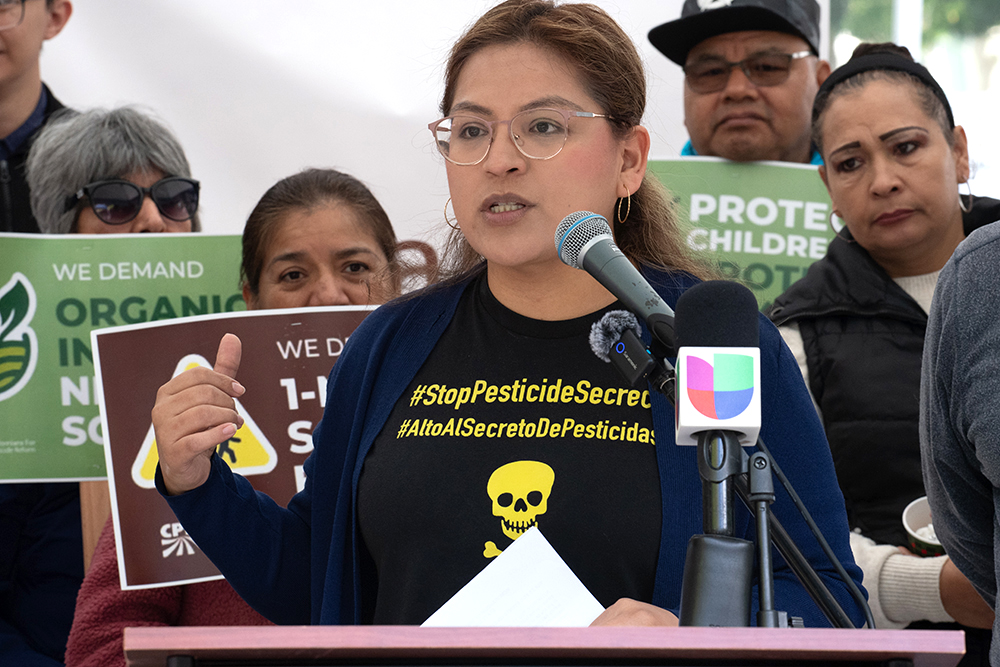
On Nov. 18, communities across Fresno, Modesto, Watsonville and Oxnard, along with an online statewide event, held press conferences to express outrage over 1,3-D and other hazardous fumigants near schools and daycares.
Farmworker families, who are overwhelmingly Latino and Indigenous, described the risks their children face when attending schools and living near heavily fumigated fields. The Department of Pesticide Regulation’s (DPR) recent regulations allow schoolchildren to be exposed to 14 times more 1,3-D than the safe exposure level calculated by the Office of Environmental Health Hazard Assessment (OEHHA).
This isn’t just a regulatory failure—it’s environmental racism. In the 10 California counties with the highest 1,3-D use, eight are majority Latino, and pesticide exposure in these communities is 10 times higher than in counties with smaller Latino populations. Farmworker communities are the backbone of California agriculture, yet their children are being sacrificed to protect corporate profits.
Gabriela Facio, senior policy strategist with Sierra Club California, summarized it plainly: “California has created an environmentally racist regulation that sacrifices Latino and Indigenous kids for the profits of 1,3-D manufacturer Dow Chemical.”
The problem is compounded by weak assumptions in DPR’s “occupational bystander” regulations. The rules assume farmworkers only work from 8 a.m. to 4 p.m., that children and residents outside the fields are not exposed before or after work, and that retired adults are not at risk in homes where chemicals drift. These assumptions ignore real-world exposure and rely on a computer model that has consistently underestimated 1,3-D levels in communities.
Public health nurse and Safe Ag Safe Schools member Erika Alfaro explained that “when science is ignored, injustice thrives.”
The impact is clear. Fumigant use near schools has increased dramatically over the past decade. In 2010, Fresno County saw 9,371 pounds of 1,3-D and chloropicrin applied within one-quarter mile of schools; by 2022, that figure had jumped to 14,648 pounds, a 56% increase. Across the 15 counties with the highest pesticide use, combined 1,3-D and chloropicrin use within one-quarter mile of schools rose 45% between 2010 and 2022.
These chemicals are not only harmful to children but also highly volatile, making even brief exposure dangerous.
Despite previous California policies requiring one-quarter mile buffer zones around schools and limiting fumigant applications to weekends, monitoring data show that air concentrations near schools remain far above safe levels. The OEHHA-established cancer risk thresholds are routinely exceeded by 2.3 to 30 times.
Teachers, parents and community leaders continue to witness children playing outside while hazardous chemicals drift through the air. Second grade teacher Oscar Ramos commented, “This is a policy of environmental racism…We must stop attacking and sacrificing our schoolchildren in farmworker communities.
“We’re supposed to protect our children. Let’s protect them from these invisible but truly harmful pesticides.”
The solution is clear and urgent. Californians for Pesticide Reform (CPR) and its allies are calling for three immediate actions:
- The State of California must phase out fumigants entirely.
- School buffer zones must be expanded from the current one-quarter mile to at least one full mile to reduce children’s exposure.
- Agricultural commissioners and DPR must fund and implement pilot projects to replace fumigated areas with organic farming in and around school buffer zones.
These measures are achievable, cost-effective and essential to protecting public health. The problem is not limited to 1,3-D; it extends to the entire class of drift-prone fumigants that disproportionately affect farmworker communities. California has the resources, expertise and moral obligation to correct this injustice.
Farmworker families are not asking for charity—they are asking for basic protections that every child deserves: clean air, healthy schools and the ability to grow up free from unnecessary chemical exposure.
Communities from Fresno to Oxnard are mobilizing, attending press conferences and demanding action. Public support for stronger pesticide regulations is growing, but state leadership must act decisively.
Every child in California deserves a safe environment to learn, play and grow. We cannot continue to allow unscientific regulations, influenced by industry interests, to endanger children in Latino and Indigenous communities.
It is time for DPR and local agricultural commissioners to prioritize health over profit and implement policies that genuinely protect all Californians.
The health of our children and the future of our communities depend on it.
Cristina Gutierrez was a farmworker and is a mother of four. She advocates for voter rights here and in Mexico. Currently, she is the San Joaquin Valley regional environmental justice coordinator of Californians for Pesticide Reform.