Across California, farmworker communities are sounding the alarm: The state’s regulation of the cancer-causing fumigant 1,3-dichloropropene (1,3-D, brand name Telone) is not only dangerously unscientific but environmentally racist. This chemical, used extensively on almond, walnut, berry and grape crops, is a known carcinogen, a lung irritant and a toxic air contaminant banned in 40 countries. Yet California allows exposure levels far higher than what the state’s own scientists have determined are safe.
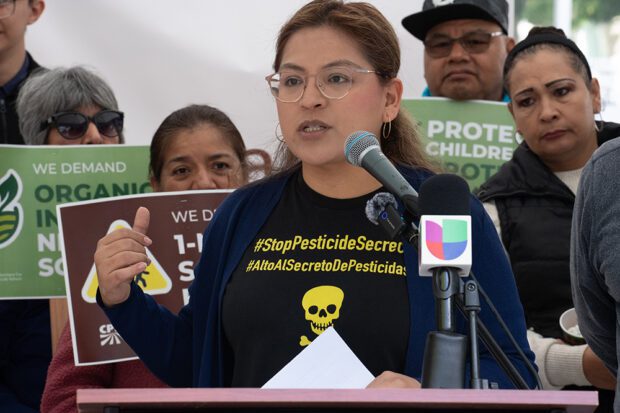
On Nov. 18, communities across Fresno, Modesto, Watsonville and Oxnard, along with an online statewide event, held press conferences to express outrage over 1,3-D and other hazardous fumigants near schools and daycares.
Farmworker families, who are overwhelmingly Latino and Indigenous, described the risks their children face when attending schools and living near heavily fumigated fields. The Department of Pesticide Regulation’s (DPR) recent regulations allow schoolchildren to be exposed to 14 times more 1,3-D than the safe exposure level calculated by the Office of Environmental Health Hazard Assessment (OEHHA).
This isn’t just a regulatory failure—it’s environmental racism. In the 10 California counties with the highest 1,3-D use, eight are majority Latino, and pesticide exposure in these communities is 10 times higher than in counties with smaller Latino populations. Farmworker communities are the backbone of California agriculture, yet their children are being sacrificed to protect corporate profits.
Gabriela Facio, senior policy strategist with Sierra Club California, summarized it plainly: “California has created an environmentally racist regulation that sacrifices Latino and Indigenous kids for the profits of 1,3-D manufacturer Dow Chemical.”
The problem is compounded by weak assumptions in DPR’s “occupational bystander” regulations. The rules assume farmworkers only work from 8 a.m. to 4 p.m., that children and residents outside the fields are not exposed before or after work, and that retired adults are not at risk in homes where chemicals drift. These assumptions ignore real-world exposure and rely on a computer model that has consistently underestimated 1,3-D levels in communities.
Public health nurse and Safe Ag Safe Schools member Erika Alfaro explained that “when science is ignored, injustice thrives.”
The impact is clear. Fumigant use near schools has increased dramatically over the past decade. In 2010, Fresno County saw 9,371 pounds of 1,3-D and chloropicrin applied within one-quarter mile of schools; by 2022, that figure had jumped to 14,648 pounds, a 56% increase. Across the 15 counties with the highest pesticide use, combined 1,3-D and chloropicrin use within one-quarter mile of schools rose 45% between 2010 and 2022.
These chemicals are not only harmful to children but also highly volatile, making even brief exposure dangerous.
Despite previous California policies requiring one-quarter mile buffer zones around schools and limiting fumigant applications to weekends, monitoring data show that air concentrations near schools remain far above safe levels. The OEHHA-established cancer risk thresholds are routinely exceeded by 2.3 to 30 times.
Teachers, parents and community leaders continue to witness children playing outside while hazardous chemicals drift through the air. Second grade teacher Oscar Ramos commented, “This is a policy of environmental racism…We must stop attacking and sacrificing our schoolchildren in farmworker communities.
“We’re supposed to protect our children. Let’s protect them from these invisible but truly harmful pesticides.”
The solution is clear and urgent. Californians for Pesticide Reform (CPR) and its allies are calling for three immediate actions:
- The State of California must phase out fumigants entirely.
- School buffer zones must be expanded from the current one-quarter mile to at least one full mile to reduce children’s exposure.
- Agricultural commissioners and DPR must fund and implement pilot projects to replace fumigated areas with organic farming in and around school buffer zones.
These measures are achievable, cost-effective and essential to protecting public health. The problem is not limited to 1,3-D; it extends to the entire class of drift-prone fumigants that disproportionately affect farmworker communities. California has the resources, expertise and moral obligation to correct this injustice.
Farmworker families are not asking for charity—they are asking for basic protections that every child deserves: clean air, healthy schools and the ability to grow up free from unnecessary chemical exposure.
Communities from Fresno to Oxnard are mobilizing, attending press conferences and demanding action. Public support for stronger pesticide regulations is growing, but state leadership must act decisively.
Every child in California deserves a safe environment to learn, play and grow. We cannot continue to allow unscientific regulations, influenced by industry interests, to endanger children in Latino and Indigenous communities.
It is time for DPR and local agricultural commissioners to prioritize health over profit and implement policies that genuinely protect all Californians.
The health of our children and the future of our communities depend on it.